
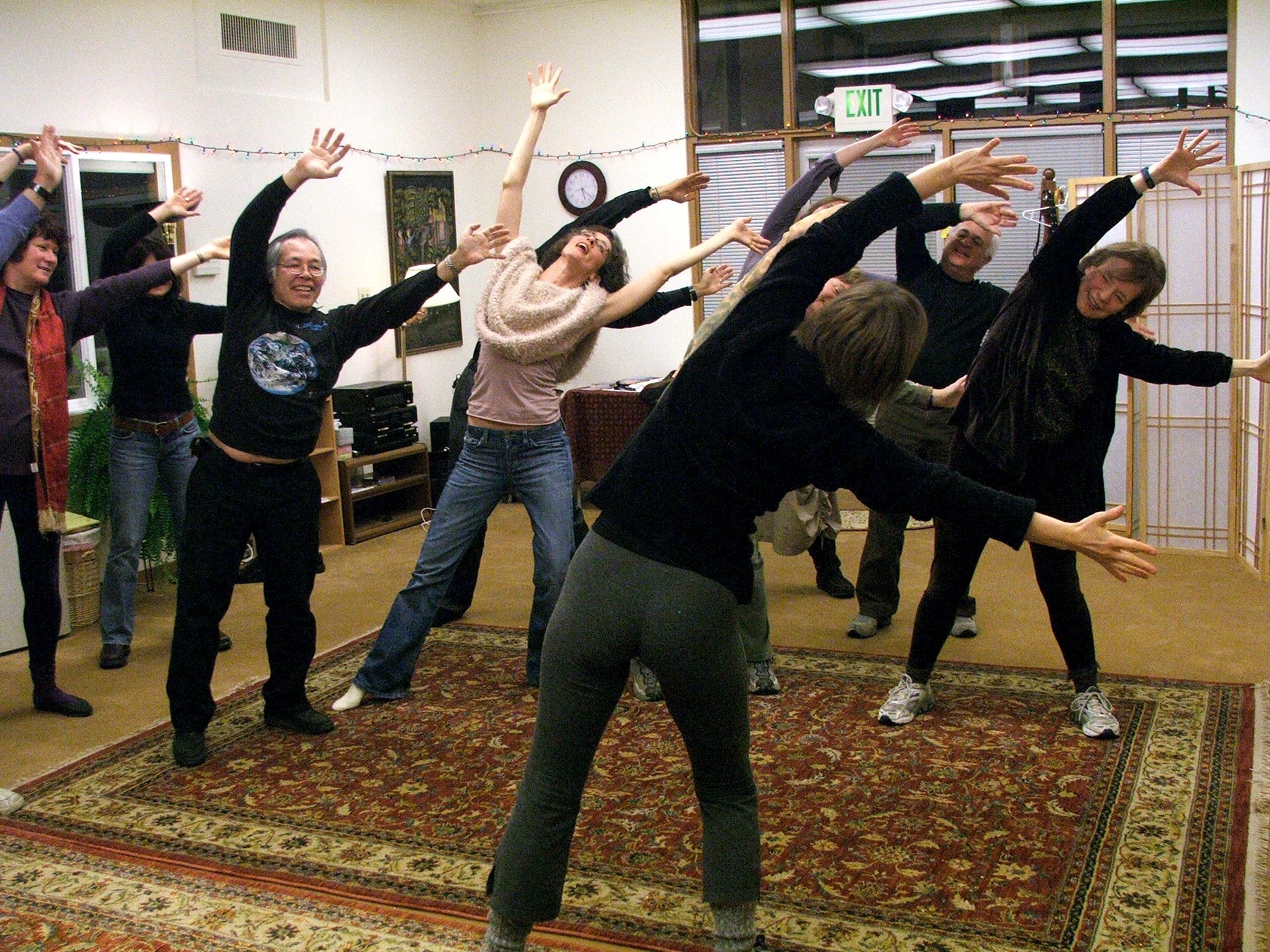
Source: Miriam Perez, www.miriamdance.com, ©2019
Somatic healing practices have been well researched1 now, and it is widely accepted that there are significant health benefits to somatic movement.
Somatic movement is an umbrella term for various types of mindfulness practices that involve moving the body. These include yoga, tai chi and qi gong, and even exercise practices like Pilates. A somatic movement can really be anything, when mindfulness and awareness of the body are included with the physical aspects of the practice.
Sacred or spiritual dance absolutely qualifies as somatic movement, and, like all somatic movement, carries the same healing benefits, positively affecting mood, physical health and emotional resilience, through the release of healing hormones like endorphins, dopamine and oxytocin, and the clearing of hormones like cortisol, that can have harmful effects when exposure is high.
The results are a reduction in stress and inflammation, and an increase in clear-headedness and focus. Performing sacred dance (or other somatic movement) in groups, seems to increase these benefits even more, just as with other healing activities (like laughter). That boost of connection to community, or to something else outside of ourselves, delivers something extra that makes our healing practices even more impactful.
Whether it’s a Sufi zikr, or an Orisha Oshun dance, or a Nepali Mandala dance, in addition to strengthening one’s connection to the divine, or spirit, all practices correlate to positive health outcomes, especially when performed with community.
So, if you feel comfortable moving with a group, you will experience an increased sense of belonging, connection to others, emotional contentment or even enlivenment! Practicing together improves both our connection to spirit, AND connection to community.
But, don’t let self-consciousness stop you. Dancing by oneself offers similar benefits, and anything that gets you moving is better than not moving at all. Also, when it comes to somatic healing, there is no correct type of movement: intention and mindfulness combined with physical activity (whether stretching, dancing, running, spinning, or whatever strikes your fancy) is what matters. Focusing on a sense of connection, and tuning into your body (whether through “trance” or “meditation”) are the elements that enable your movement to become more than exercise, and open the path to spiritual, emotional and mental transformation and wellbeing.
- A couple of references with links:
Body-oriented psychotherapy: The state of the art in empirical research and evidence-based practice: A clinical perspective.
Journal of Body, Movement & Dance in Psychotherapy, 2009, Vol. 4, No. 2, pp. 135-156.
Author: Röhricht, F.
Available from: http://www.eabp.org/docs/BOPT%20State%20of%20the%20Art.pdf
Evaluation of the effectiveness of Body Centred psychotherapy in out patient settings: A multi centre study in Germany & Switzerland.
Journal: Psychotherapie Psychosomatik medizinische Psychologie
Volume 56, 2006, Pages 480-487
Authors: Koemeda-Lutz, M., Kaschke, M., Revenstorf, D., Schermann, T., Weiss, H., & Soeder, U.
English translation available from:
http://www.hakomiinstitute.com/Forum/Issue19-21/12EABPresearch.art2.pdf
(Thanks to Ajay Hawkes of Uplift Counselling for the references)